
A small pool leaves little room for guesswork
Many Tequesta backyards hold a modest pool, sometimes with a small attached spa, set into a deck of pavers or natural stone and framed by landscaping that has had decades to grow in. On a salt system, a smaller volume of water reacts quickly. One heavy-handed dose of acid, one bag of salt too many, or one stretch of high production during a cool week can push the water out of range faster than it would in a larger pool.
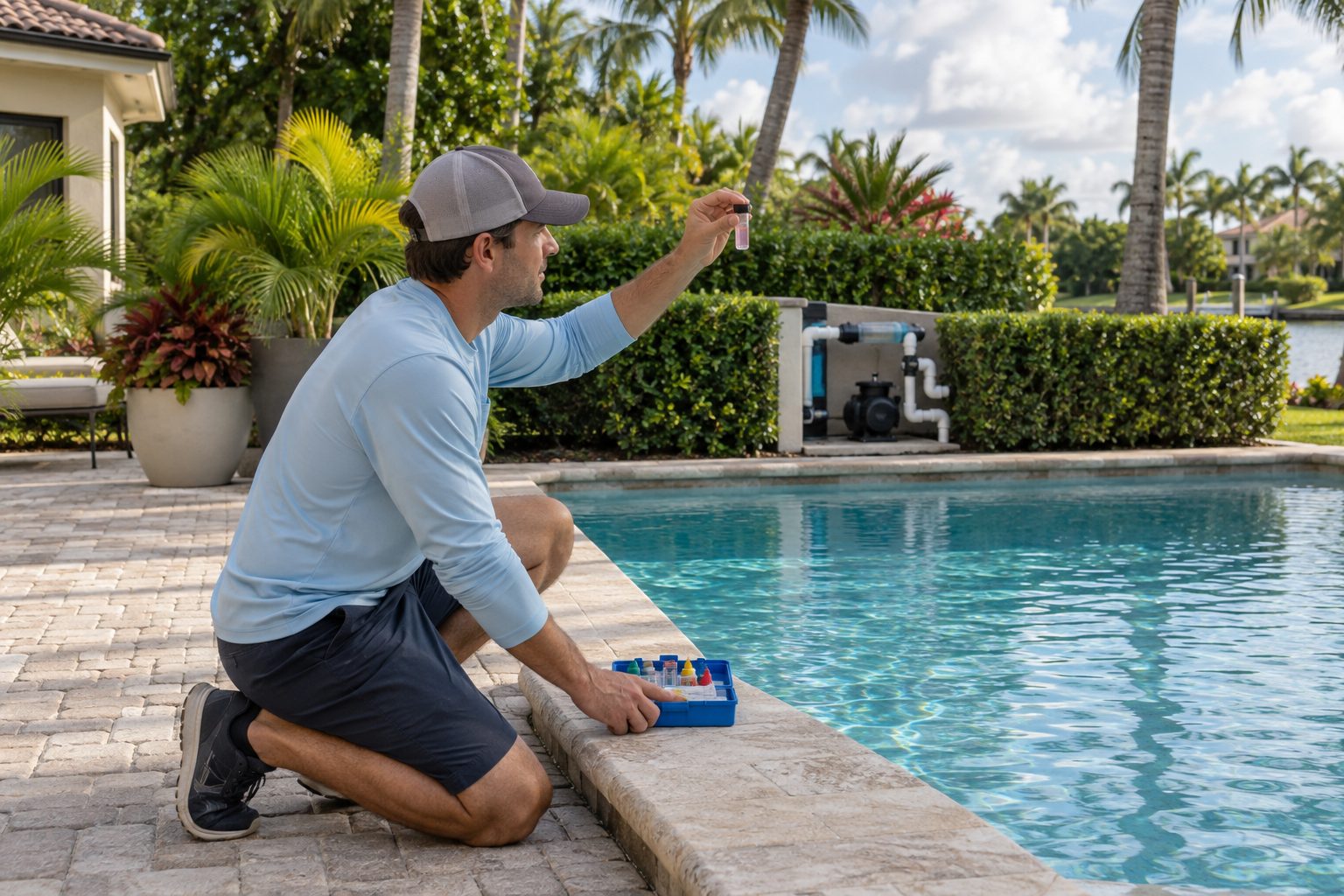
That is why we treat dosing on compact Tequesta pools as a measuring job, not an estimate. We test independently, calculate additions against the pool's actual volume, and make adjustments in smaller steps. Overshooting salinity is a common and annoying mistake, because the only practical way to bring salt down is to drain and refill part of the pool. Rain cuts the other way: a soaking summer storm on a small pool can thin salt and stabilizer enough to notice at the next visit, so we test after wet weeks rather than assume.
What a weekly visit checks on a compact salt pool
- Free chlorine, pH, alkalinity, stabilizer, and calcium tested by our own kit, not read off the control panel.
- pH brought back down in measured amounts, since salt generation keeps nudging it upward and small volumes swing further.
- Salinity confirmed before any salt goes in, with additions sized to the gallons actually in the pool.
- The cell inspected for white scale on its plates and cleaned when its condition calls for it.
- Production output adjusted to the season, so the cell is not overproducing in a small pool during cooler months.
- Skimming, brushing, vacuuming as needed, and baskets, with fine leaf and flower debris from mature yards cleared before it reaches the filter.
Salt, stone, and pavers
Salt pools splash, and the water that lands on the deck dries and leaves its salt behind. On some surfaces you may notice a faint white film near the waterline or around steps where swimmers climb out. Some natural stone and certain pavers can be more sensitive to repeated salt exposure over time than others, which is one reason many deck installers recommend sealing and periodic rinsing. How a specific stone will age is a question for the installer or a stone professional, and we do not install, seal, or repair decks.
What we can do is keep the water itself in balance, which matters for the surfaces it touches. Water with high pH and high calcium tends to leave more scale on tile, coping, and stone edges. Keeping salinity at the level your cell actually needs, rather than above it, also means less salt on the deck after every splash. If we notice buildup forming where pool water meets stone, we mention it so you can take it up with the right person early.
Cost and how to start
Weekly service for a standard screened pool starts at $170 per month with routine chemicals included, saltwater adds $20 per month, and Tequesta pools may run $10 to $20 higher than the same pool on the Treasure Coast. An attached spa is priced separately on the rate card. Salt cell cleaning runs $60 to $75 when needed, and salt is billed separately and discussed first. Call or text (772) 919-9365 or request a quote, and tell us the pool's size and whether it has a spa.
Frequently Asked Questions
I added salt and now the reading is too high. What do I do?+
Stop adding and let us confirm with an independent test first, since panel readings can be off. If salinity truly is high, the fix is partial draining and refilling with fresh water. How much water comes out depends on how far over target the salt is, and we calculate it before anything is drained.
Is salt water bad for my stone deck?+
It depends on the stone, the paver, and whether it has been sealed, so we do not make predictions about a specific surface. Rinsing splash areas and asking your installer about sealing are reasonable steps. We keep the water balanced and point out buildup when we see it.
Do small salt pools need the cell cleaned as often as large ones?+
Not necessarily. Cell scaling follows water balance and production hours more than pool size. A small pool with pH kept in range may need cleaning only occasionally. We inspect the cell regularly and clean it when it shows scale.
Can a salt system run a small spa too?+
Often, yes, when the spa shares the pool's water and circulation. Spa use changes chlorine demand quickly in a small volume, so we check the spa's water along with the pool at every visit.