
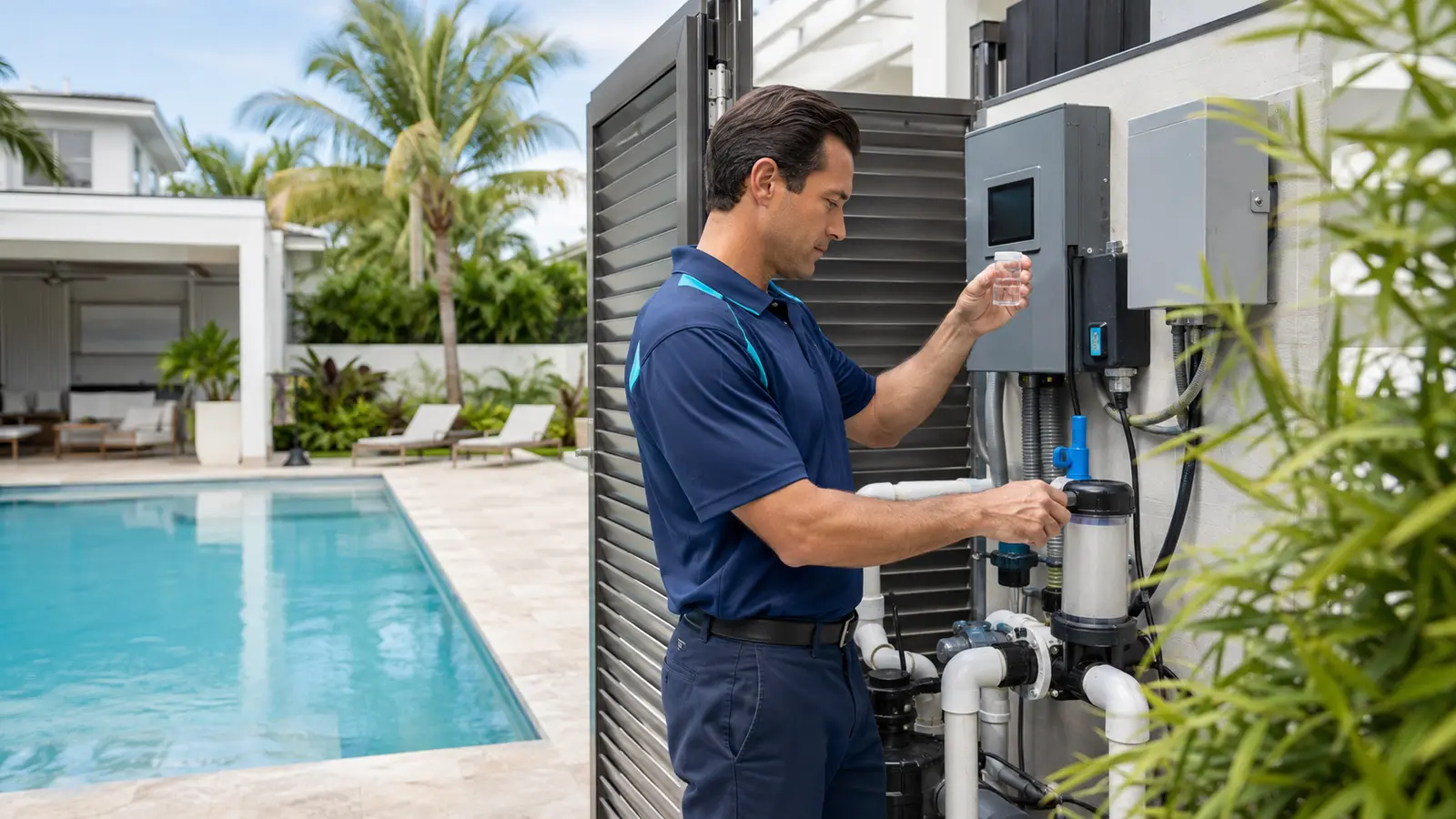
Saltwater pools are often marketed as low-maintenance, and compared with manually feeding chlorine, they can be more convenient. But “low-maintenance” is routinely misunderstood as “maintenance-free.” Florida heat, rain, sunlight, scale and year-round operation still affect the pool every day.
That is especially true across Palm Beach and the Treasure Coast, where a salt cell may be asked to keep up with warm water, intense sun, heavy rain and frequent swimming for much of the year.
How a saltwater pool actually works
Pool water contains a controlled concentration of dissolved salt. As water moves through the salt cell, an electrical process called electrolysis converts chloride into chlorine. The chlorinated water returns to the pool, treats contaminants and continues through the cycle.
The pool is therefore not chlorine-free. It is a chlorine pool with an on-site chlorine generator. The water may feel different because the salt concentration is far below seawater and chlorine is produced steadily rather than added in larger manual doses.
Manufacturers are explicit about the limitation. For example, the Pentair IntelliChlor manual states that the device produces chlorine but does not maintain the proper free-chlorine level on its own. Output, pump runtime, salinity and water chemistry still have to be monitored.
What should be checked every week?
Free chlorine and pH
Chlorine production must match the pool’s actual demand. A setting that worked in March may not keep up with August heat, longer days, storms or a large gathering. Free chlorine and pH should be tested, then the cell output or pump schedule adjusted as needed.
Saltwater pools also tend to experience upward pH movement. The rate varies, so acid should not be added blindly on a fixed schedule. Test results should control the adjustment.
Pool surfaces and debris
A salt cell does not skim leaves, brush steps, vacuum the floor or clean the tile line. Organic debris consumes sanitizer, and low-circulation areas can develop algae even when the controller shows normal operation. Weekly brushing is particularly important around steps, benches, corners, spas and waterline features.
Circulation and filtration
The generator produces chlorine only while properly powered and receiving adequate water flow. A clogged basket, dirty filter, low water level or failed pump can stop production. The technician should observe flow, filter pressure, pump prime and warning lights as part of normal service.
Controller status and visible scale
Low-salt, low-flow, temperature and cell-service indicators should not be ignored. The cell and unions should also be checked for leakage and obvious calcium buildup. A warning light is a reason to investigate, not simply increase the output.
What needs periodic or monthly attention?
- Independent salinity testing: verify the actual salt level rather than relying only on the controller display.
- Total alkalinity: manage pH stability and overall water balance.
- Calcium hardness: reduce the risk of aggressive water or scale formation.
- Cyanuric acid: provide appropriate chlorine protection from sunlight without allowing excessive buildup.
- Cell inspection: look for calcium deposits, damaged plates or connection problems according to the manufacturer’s instructions.
- Full equipment review: inspect the pump, filter, valves, automation, heater and bonding-related components that affect the system.
Exact targets vary by generator and pool. For example, Pentair publishes model-specific ranges for salinity, chlorine, pH, alkalinity, calcium hardness and stabilizer. The equipment manual should control rather than a generic chart copied from the internet.
Why salt cells fail early
A cell is a wear component. It has a finite coating and a finite number of operating hours. Running at maximum output around the clock can use that life faster. Scale on the plates reduces performance and can make the system work harder. Low salinity, improper flow, poor water balance and neglected cleaning can also shorten useful life.
Many residential salt cells are designed for thousands of operating hours, with some manufacturers describing roughly three to five years under typical conditions. Actual life can be shorter or longer depending on model, pool demand and care. The meaningful question is not only “How old is the cell?” but “How many hours has it operated, under what conditions, and is it still producing?”
Four common saltwater-pool myths
| Myth | Reality |
|---|---|
| “There is no chlorine.” | The generator creates chlorine from dissolved salt. |
| “The controller balances the water.” | Most salt cells produce sanitizer; they do not manage every chemistry factor. |
| “I only need to add salt once.” | Salt is lost through splash-out, overflow, leaks, filter discharge and water replacement. |
| “Saltwater pools cannot turn green.” | They can turn green whenever chlorine production falls below demand or circulation fails. |
Why Florida makes weekly attention worthwhile
Florida’s year-round season is convenient for swimming but demanding on equipment. Warm water increases sanitizer demand. Strong sunlight consumes available chlorine. Rain dilutes and displaces balanced water. Storm debris increases organic load. In many pools, scale develops faster because pH and calcium are not managed together.
Weekly service creates a chance to adjust output before the water changes color, spot a low-flow warning before the cell stops producing and correct pH before scale hardens on tile and plates. That preventive work is usually less expensive than green-pool recovery or premature cell replacement.
A sensible saltwater maintenance plan
- Test the water and inspect the pool every week.
- Adjust cell output and pump runtime seasonally and after major changes in use.
- Brush, skim and vacuum according to actual pool conditions.
- Check baskets, flow and filter pressure during every service visit.
- Verify salinity independently and follow the generator’s published range.
- Inspect and clean the cell only as the manufacturer directs.
- Record warning codes and diagnose repeated errors instead of clearing them and walking away.
Frequently asked questions
Is a saltwater pool chlorine-free?
No. The generator converts dissolved salt into chlorine. It changes how sanitizer is supplied, not the type of sanitation.
How often should it be serviced in Florida?
Most Florida residential saltwater pools benefit from weekly testing, cleaning and system observation, plus periodic detailed water and cell checks.
Why does the pH keep rising?
Salt chlorine generation and aeration can contribute to upward pH movement. Test and adjust based on the pool rather than adding acid by calendar.
How long should a salt cell last?
Many cells are designed for thousands of operating hours. Actual life depends on output, run time, salinity, water balance, scaling and maintenance.